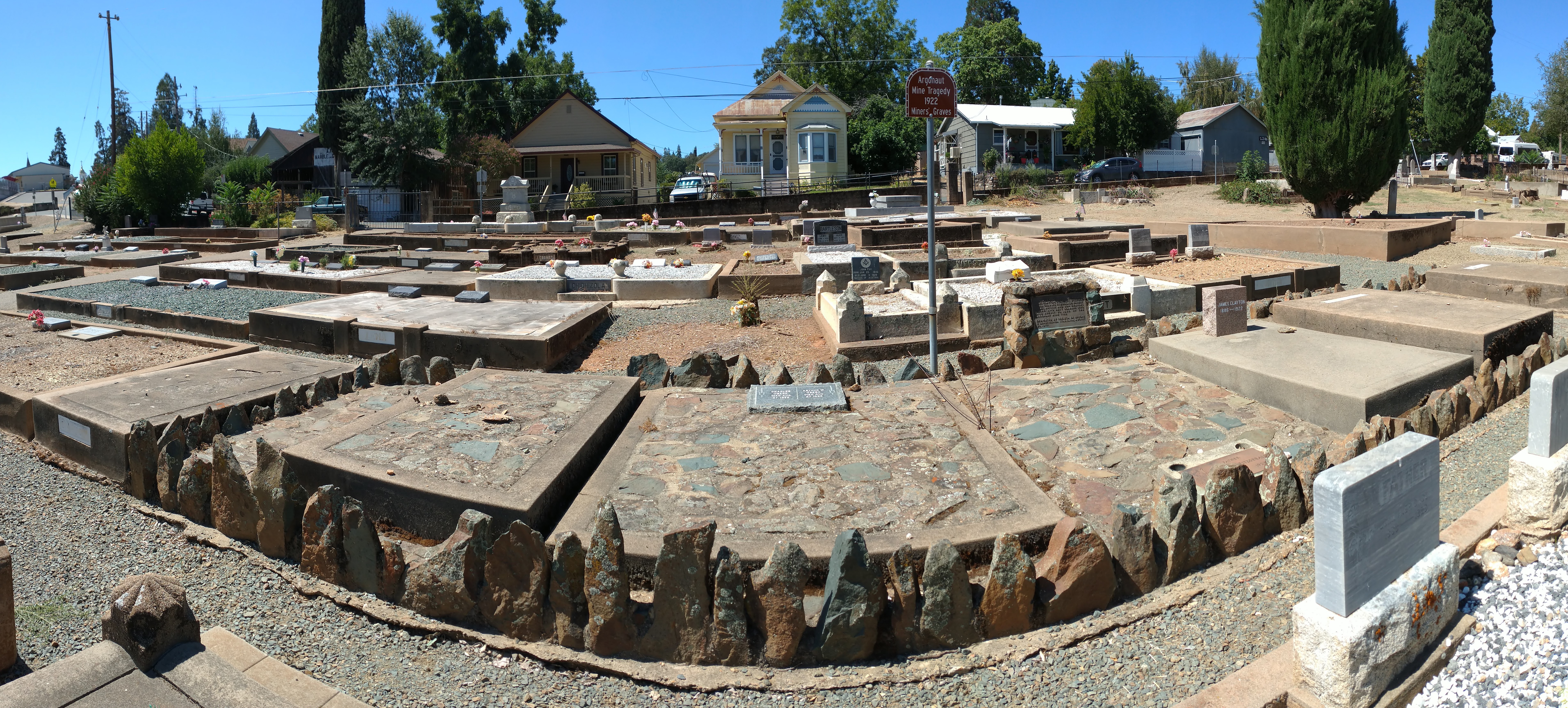
Going back to the first burials of the 46 miners discovered, those burials took place at the Protestant Cemetery (Jackson Public Cemetery, as well as at St. Patrick's Cemetery (The Catholic Cemetery), and lastly at St. Sava Serbian Cemetery. Of course, when Fessel was discovered a year later, he too, was brought to the Protestant Cemetery and interred there along with his fellow mining friends.
Miners Buried in the Protestant Cemetery (Jackson City Public Cemetery):
Charles Fitzgerald, who is buried next to his best friend James Clayton, had been living a double life for some time.
Apparently, he and his wife, Frances had been somewhat estranged for a period of time. They had two children, but at the time that he was working at the Argonaut, she had been staying in Oakland. She had their daughter, while he had their son.
When news broke that Charles was among the trapped miners, Frances rushed to support the rescue effort and apparently when she arrived she was met by another woman who was claiming to also be Charles’ wife. No, he wasn’t a bigamist, but he had been living with another woman, Emily Ludekins.
According to the San Francisco Call, Frances paid Emily a visit at her cottage near the Argonaut. There was no record of what was exactly spoken between the two women, but on September 18, 1922, the newspapers claimed that Charles' wife attempted to kill herself by way of poison. The Sacramento newspaper said it was Frances who made the suicide attempt. However, the San Francisco Call states that it was actually Emily who took the poison, as she could not bear life without Charles.
Thankfully, Amador County Physician, Edwin Eugene Endicott
came to her aid early enough and successfully saved her life. Interestingly,
Dr. Endicott, who was also the physician at the Preston School of Industry, is
buried only feet from where Charles Fitzgerald is interred at the Public
Cemetery in Jackson.
Elmer Lee Bacheller, was a native of California, and originally lived in Stockton. His occupation was listed as a Carpenter. A lodger at the Gallino Boarding House in Sutter Creek, and he was not even an employee of the mine. He had volunteered to work the shift of a friend (fellow lodger) who went on vacation and it just so happened the shift he filled in was the day of the mine disaster.
Ernie Miller, the Jigger Boss on shift that night, was just 37 years old. A native of Illinois, Ernie left behind a wife and 2 children. He had survived the Speculator Mine Disaster – aka Granite Mountain Mine Disaster in Butte Montana just a few years earlier.
Charles & Arthur O'Berg, Father and son. Charles was Level Boss that night. Charles was a native of Sweden, and Arthur was born in Washington. The saddest part of their story was that both men had never worked same shift before. Charles had only arranged a few days earlier to have the same shift, as he was planning to retire in 1923. Charles and Arthur’s bodies were discovered hugging onto one another up against the wall, their bodies had been fused to one another so they were buried in the same grave.
Bert Seamans was a California native, former resident of Stockton, and only 38 years old. Both Seamans and Bacheller do not have a marker, and are only noted on the plaque.

Miners Buried in St. Patrick's Cemetery (Catholic Cemetery)
Peter Bagoye, 24 years old. Native of Austria. Had only been in the U.S. for four months prior to his death. He didn't even have a chance to send for his young wife to be with him in the states.
Rafaelo Baldocchi, was 29 years old and a native of Italy.
D. Boleri, was a native of Italy.
Eugene Buscaglia, was 25 years old. Eugene was living at the Buscaglia's Boarding House on Jackson Gate Road, so I am assuming he was related given the same surname. He was also listed as single in the census records.
John Caminada, was 24 years old, and also a native of Italy.
Peter Cavaglieri, 40 years old, a native of Italy and he was married, with three children.
Paul De Longa, was a native of Austria and was 31 years of age.
A. Fazzina, was 37 years old and was a native of Italy.
V. Fidele, was 38 years old and a native of Italy.
Simone Francisconi, age 48, and also a native of Italy.
Battista Gamboni, a native of Switzerland, aged 33.
Timothy Garcia, 48, native of California, a widower with 2 children.
Maurice Gianetti, 44, native of Italy.
Giuseppe Giorza, aged 36, married with 5 children.
Lucio Gonzales, 28, native of Italy.
Manuel Kosta* (sometimes spelled Manuel Costa), 47, native of Portugal. *(some records state he was born actually on January 11, 1886, which would have made him 36 at the time of his death. WWII Draft Registry cards state that he had previously lived in the town of Ripon, San Joaquin County as a farmer before coming to Amador County to work at the Argonaut.)
Antonio Leon, age 33, native of Spain.
Luis Leon, aged 42, native of Spain.
Battista Manachino, age 40, a native of Italy.
Pio Oliva, native of Italy. Aged 25, his brother Luigi also worked at the mine, but played hookie that night to go to San Francisco with friends, and ultimately that saved his life.
Emanuel Olobardi, age 27, native of Italy. San Francisco Call dated 9/18, Emanuel's wife spoke to the newspaper reporters that her husband had a premonition prior to the accident.
September 18, 1922 edition of the San Francisco Call states:
"It is also reported that O. Bardi (Emmanuel Olobardi), one of the unfortunate forty-seven, expressed his belief to his wife that “something terrible was about to happen.” He had attended a celebration of the Italian Benevolent Society with his wife. Just before leaving her to take his place with the 11 o’clock shift, he said he felt as though he ought to stay home, but, like Steinman, on second thought, he determined to cast aside his fears.”
Aldino Piagneri, 27 years old and a native of Italy.
Giovanni Ruzzo, 28 years old. Born in Sardinia.
Domenico Simonde, 47 years old, native of Italy.
George Steinman, 48 years old. Native of Michigan. Had been married twice, and had a total of 4 children. His 2nd wife, Linda had one child with him.
The same newspaper clipping as noted above mentioning Emanuel Olobardi's premonition, also mentions the following:
“George Steinman, one of the imprisoned miners, told his wife just before descending to work that he feared something was going to happen. Before kissing her and their children goodbye, Steinman said, “I don’t want to go down for some reason tonight, but maybe it is just a bum hunch, and I guess I’d better go. He went and his premonition soon was to be realized. -- San Francisco Call, September 18, 1922
Daniele Villia, 43 years old and a native of Sardinia.
Cesare Zanardi, native of Italy.

Miner's Buried in St. Sava Serbian Cemetery
(**Although all of the miner's names were listed multiple times in the newspapers of the time, most of their personal information was only available due to the amazing work of O. Henry Mace, who diligently searched for these miner's countries of origin for his book, "47 Down.")
There are not a lot of records about these fallen miners, given the fact many of them had just come over from their home countries.
Rade Begovich, 36, native of Yugoslavia.
Marko Janovich, 35, native of Serbia.
Milos Jovanovich, 36, native of Montenegro.
Jefto Kovac, 42, native of Herzegovina.
Rade Lajovich, 33, native of Montenegro.
Steve Marinovich, 46, native of Serbia.
John Maslesa, 32, native of Herzegovina.
Todore Miljanovich, 37, native of Herzegovina.
Elia Pavlovich, 40, native of Dalmatia.
Niko Stanicich, 40, native of Serbia.
Mike Vujovich, 28, native of Herzegovina.
The Survivors
There were only 3 survivors of the Argonaut Mine Disaster, Clarence Bradshaw, Steve Pasalich and Mitchell Jogo.
Clarence Bradshaw was born in 1868, and a native of California. He lived on Stasal Avenue in Jackson near the cemetery, and was married to Sarah Bradshaw. He had been working at the Sheriff's office at one point in time. He died in 1926, around the age of 57 years old.
According to his naturalization papers, Mitchell Joko was born in Austria on December 28, 1882. By 1911, when he was naturalized, he was living at 41 Broadway street in Jackson. Mitchell died on September 3, 1923 at the age of 39.
Steve Pasalich, is probably my favorite character in this story, not only because this story started with him, but because he is the grandfather of a dear friend, George Pasalich, and also because my parents rented the downstairs apartment (lower level) of Steve's home on Stasal Street in Jackson, many years ago, forever tying my family to the Pasalich family.
Steve was born on March 25, 1890 in Yugoslavia. He came over to the United States with other family members through Ellis Island. According to the ship's manifest, each of them had about $26 on them, and they were planning to come to the west coast so they had to make that money last, or work to make money to make it to California. So, Steve would shovel snow on the railroad tracks in order to make extra money.
One of George's funny stories about his grandfather that he shared with me was that when he grandfather had made it to Chicago, he needed to purchase some food, and went into a store and wanted to get chicken but the clerk didn't understand him because he only spoke Serbian. He had to literally play charades and mimic a chicken in order to get the clerk to understand that he was asking for chicken.
He eventually made it to California, and settled in Jackson. He started working at the Argonaut mine for many years, and later onto the Eureka Mine. He eventually passed away in 1964, and is buried at the St. Sava Serbian Church. His grave is in the front of the churchyard.
Steve's story was very emotionally moving for me knowing that he survived such a horrific disaster. George shared a story with me a few years ago about his grandfather and his tie to the miners even in death. It was after all the miners were buried, there were little individual flags left on everyone's graves. Over time, the elements had abused the flags making them become tattered and torn, so Steve decided to remove them and took them home with him, and put them in his basement for safe keeping. (This was before he turned the basement into a second residence.)
Soon Steve started hearing noises in the basement. The movement down there was very loud, as if someone was down there moving things around, or making loud banging sounds, even when no one was there. So he started feeling very uneasy, and he eventually he removed the flags from the basement --- and the odd occurrences suddenly stopped.
Later on, he would turn that basement into an apartment, which my parents ended up renting years later. Of course my parents had no paranormal experience in that house, so it was safe to say that whatever paranormal occurrences that took place there were tied to the flags and stopped when the flags were removed.
_2.JPG)
When all was said and done regarding the cause of the Argonaut Mine Disaster, there were no real answers. The cause of the fire was never determined as a certainty, and it also brought up so many safety violations that had been overlooked.
The
Report of Governor Stephen’s Committee of Inquiry on the Argonaut Mine
Disaster, published in Volume 114 of the Engineering and Mining Journal, states:
“Origin of Fire – The evidence given regarding the cause of
the fire leads to no one definite fact.
The following possibilities have all been taken into consideration:
Incendiarism; Defective electric wiring; carelessness with
cigar or cigarette stub; carbide lamp or candle.
The witness Mitchell Jogo, who stepped off the skip
immediately after the discovery of the fire, and remained there with the hope
of being able to do something toward extinguishing it, states that while there
were two sets of timber, or possibly three, burning, the larger portion of the
fire seemed to be coming from the manway and spreading across the shaft from
there. This would warrant the belief that the fire had started in the manway.
This manway, besides carrying the ladder for the men moving up and down the
shaft, when traveling without the skip, contains the electric-power wires
carrying 2,400 volts, and also the electric lighting wires in the mine, as well
as the telephone, compressed air-line, and water pump column. If the origin of
the fire was either incendiary or caused by defective wiring, this would be the
natural place for it to start.
From all the evidence considered, your committee is unable to
arrive at a definite conclusion as to the origin of the fire, which still
remains in doubt. Of the possible cause, as previously stated, the first two,
incendiarism, or defective wiring – seem to be the most acceptable.”
Going back to my personal connection, I will always feel tied to this story from the time my dad brought home that framed photograph and hung it on our hallway wall at our home so many years ago, down to the present day.
That day, so many years ago, started my passion to learn about local history and it also triggered the empathy and compassion I feel for those I research and write about. I want to tell their stories for them, since they are not able to do that themselves. I feel everyone has a story to tell, and I feel honored to be the one who gets to do that for them.
This August 2022, marked the 100 year anniversary of this tragic event. Roland and I met my father at the cemetery and we paid our respects to all 47 fallen miners, and the 3 survivors who lived to tell the tale.
Sadly, we will never truly know what or whom started the fire that killed 47 miners, and destroyed many lives that night in August of 1922. We can speculate, but we will never have a definitive answer. But we can always pay our respects and share their stories, so that they will never be forgotten.
May those who perished that day rest in peace.
(Copyright, J'aime Rubio 2022 - www.jaimerubiowriter.com )


